

The Novalaxia Compendium™
are labels & genre codifications restraining otaku thought?
Apr. 19, 2026 8:00 PMI am often unwilling to elaborate on ideas and topics already discussed at length in writing, contrary to the aforementioned. My previous espousings on the relevance and specialist need for "genres" and labels have established that such language ultimately proves meaningless for audiences with a clear understanding of topics at hand. At risk of portraying myself a terminology extremist, I feel that many audiences and fans alike rely on genres as a descriptive crutch, hoping others share their lack of broad experiences and inability to articulate their enjoyment of specific works at length in a public environment. Refined pedantry.
The self-renewed focus on this subject (hopefully the last time in blog context) was sparked by a recent, and lengthy, discussion with a friend split across the course of several days. Sparked by a blogpost regarding otome games published exactly a week ago from time of first writing (11/4/2026), we talked about several tangential areas relating to art discussion and dissemination of analytical ideas within subcultures of interest - namely, the reality that detailed musings are few and often lacking in quality. Our respective thinkpieces partially focused on how genres are codified by general audiences, while also questioning the rigid criteria used to classify, define, and separate, fields of niche artforms.
Many of the following thoughts were broken up over a week of intermittent messages between my work lunch breaks, but I would like to summarise any relevant points we considered regarding genres and labels to better articulate my views on the subject. I conversely also wish to challenge my existing positions on the necessity for genre terminology among specialist groups and audiences. Perhaps I was going too far? Let's dwell on it together.
genre codifications as a metric of establishment, & niche consolidation
it's okay that your hyperfixation is impossible to describe. probably.
My friend, henceforth referred to as Hibari (presumably after the protagonist of VARIABLE BARRICADE) wrote at fair length regarding the term "otome." Of note, she covers its etymology rooted in contemporary codifiers like Angelique et al., how this term is misattributed by creatives with ideas that also feature BL or other romances, and its nebulous conflation with joseimuke in reference to games not strictly visual novels. Think Love and Deepspace... or, uh. Touken Ranbu??? whuh????? (note: this section in the original post got a laugh outta me)
I must clarify that any knowledge I have re: otome is entirely second-hand. Coincidentally, much of my awareness on the field at hand stems from Hibari herself, as we often share (read: one-sidedly speak at length) developments in our respective subcultures, much of which is condensible to whatever title(s) she happens to be disappointed by. However, she addresses a point I wish to elaborate upon - how do general audiences differentiate labels and genres of art fields, especially if they're relatively new or seldom analysed in detail compared to traditional mediums? The language isn't quite there yet, and everyone is technically a 'new' fan by virtue of non-existent infrastructure. It's easy for us to describe a work by salient qualities or features, but to avoid typecasting works by the language we use, or the qualities we recognise said works by, is another.
Such considerations are difficult for creatives, or audiences, to solely decide. I have previously quoted the idea that audiences have overwhelming dictation over how genres are defined, language codified, creatives typecast; rather than blaming one party, I posit these as growing pains of a subculture not yet recognised by similarly demographics. Hibari identifies this quandary, noting that otome games "don't even share the same terminology and slang as other visual novel communities." To what extent should this matter to fans? How much stake do audiences have in this race? Will a fixed delineation between otome and other male-focused works alleviate the confusion from insiders and onlookers alike? These are reflections best addressed by experts in the field, but fans and developers should be invited to tackle why such perceptions have been allowed to manifest unchecked for the sub-medium's modern lifespan.
It gets tiring seeing people with limited vocabulary defining ideas.
This is a multifaceted occurrence. Fans will often use labels and genres to highlight new works in existing mediums to anyone interested, which is then disseminated by experts and publications covering those mediums, as they study the developments in this fledgling area over time. Publishers may eventually choose to adopt the most popular terms, like otome - rather than camaraderie, some understand how this can be used as a marketing tool, quickly capturing the attention of enfranchised onlookers more familiar with popular works under that genre umbrella, rather than appealing to audiences looking for new ideas that hopefully push the creative boundaries further than what's already out there.
I'm basically summarising an entire point from one of my prior interviews, but it's worth outlining this progression in greater detail for clearer reference.
For lack of a better descriptor, genres are often used by fans as a linguistic crutch. Go onto Rate Your Music, Letterboxd, or what have you. People regularly use the genres that a work most likely falls under, in lieu of specific aspects relative to its design, because they are much easier to conflate. It's easier for me to describe a new release as "hyperflip", or Hibari categorising a game as "otome", because these are identifiers that the common audience will best understand. It may be insulting, perhaps even demeaning, to assume that fans lack the vocabulary or nuance behind discussing the minutiae behind these fields, but the honest truth is that most audiences don't know much about the inner workings. I'll return to this point later in the post, but I find that labels are used to define 'in-groups' as a way of consolidating a genre's 'legitimacy' among fans of other genres in a particular (sub-)medium. By having a label to rally behind, it gives people avenues to legitimise the works they enjoy as something more credible than a flash in the pan. One can actually pinpoint origins of a creative style, rather than collating tangentially related ideas together when understanding how such nomenclature, and by extension, denoting conventions and standardising formats, came to be.
You'll see fans of niche subcultures define their favourite works by a distinguishable term, usually far removed from existing language. It happened to "hyperflip", and "otome" seems to undertake a similar path. Hibari suggests the following regarding any "growing pains" in relation to otome:
1. The term is new in the English-speaking community, relative to other terms.
2. It's one of the few genres for women not into BL or GL, gacha or otherwise.
3. Fans, developers, and publishers sometimes conflate "otome" with BL.
Though I disagree somewhat with point 2, being what MBT would describe "a depressed bisexual with ADHD", there is probable merit to these lines of thought. Dariacore fans were originally fiercely protective of the term, to the point of forming an unspoken honour system (page 2.) While I expect that otome hasn't undergone an evolution nearly as rapid, or as tumultuous, a desire to consolidate what classifies as such is clearly apparent to me. A combined immaturity among fans and publishers alike to define the common aspects of otome has exacerbated a malaise felt by long-standing fans, as the field is undermined by one company (Otomate) forming a monopoly on localised works, while said field's general writing quality rarely develops beyond mediocrity for outsiders to seriously consider its merits. Compounding catch-22s don't help its case.
Labels are typically used by fans to ensure other people know how to describe the most popular works they encounter in that stylistic framework. I personally think that such terms undermine the language used to discuss the achievements, and contrasting pitfalls, of developing fields, but they nonetheless hold merits for the average person lacking a way to articulate specific charms. Sure, people may take new ideas seriously if there's an easy, catch-all term to describe whatever's being thrown in the box. Having a vector to consciously discuss art in a meaningful way is valuable - the problem is whether that platform is actually used for anything.
desiring more analysis in environments unable to provide
many could learn how to appropriately exercise this quality in daily life
A quote from Hibari's manifesto appropriately introduces this next point.
"It’s certainly convenient to have several people write summaries of the same story in case I forget some plot point, but I’d love to see something more deep. I’m not sure whether I can’t find what I want because nobody’s interested in writing more deep analyses of these stories or because they really aren’t deep enough to write about."
One contradiction of modern art critique is that anyone can do it. This isn't wholly negative, as I find the ruminations of normal fans to hold some value in understanding how a work became popular. On the other hand, this has encouraged two separate problems that inevitably compound the overarching difficulty of producing meaningful analysis and critique. As previously mentioned, fans rely on genres and common language as a crutch when outlining thoughts on whatever they engage with, leading to a homogenous introspective structure through use of colloquialisms and other fandom terms resulting from low interactions with yet-enfranchised fans of the category. You'll invariably see reviews and posts on games, films, and music often condensing any experiences into short, snappy one-liners or ironic memes. This ironically disincentivises audiences willing to share their perspectives in more detail, as they ask whether it's worth talking at length if few people will appreciate the notion.
Does this actually matter? Some may feel inclined, if one is annoying enough. Jokes aside, this reads like a self-fulfilling prophecy of sorts. Social media and lowering attention spans force users to compress every word into the shortest, yet most comprehensible musings possible, which has damaged our ability to express longform opinions in any way. Rather funny, me saying this. No matter the volume of complaints that more people should be encouraged to talk about their favourite art through written or video form, the sad reality is that many are ill-equipped to undertake this demand. We can't all be Roger Ebert, Nyalra, or Kastel - writing at length is a skill that just doesn't click for some of us. I'm built different, though.
Ahem. Self-aggrandising notwithstanding, this is a trouble that terribly tilts me. I briefly discussed this with Hibari, expressing concerns that "the way that people engage with art as a whole nowadays is very compartmentalised, often almost accidently (or otherwise) highlighting the failings of an importance to develop language of detailed critique and feedback." Modern fandom is poorly suited for the kinds of long rants, analyses, and reflections that inspire focused debates on facets of the human experience. Exceptions to the norm, some pieces I often best describe as contemporary otaku writing, take an ironic extreme slant in the complete opposite direction. I am familiar with the works of Azuma et al. - maybe I am the exception for distancing their writing from any self-introspection on my relation to "otaku" as a culture. Maybe it's not that deep, but I don't find any particular merit invoking names and studies in lieu of personal experiences.
this is basically what most online debates on "otaku" are like now
Modern discussions on art have spread unto two severities that I find equal concern for. Both aforementioned norms strike me as wholly devoid of respect for the mediums they cover, offering multiple facets into a generally meaningless critique of what they engage with. Hearing "media literacy is dead" strikes me as a solution to problems of our own origins, a witty shuffling of responsibility onto whatever demographic the original perspective deems as 'the enemy' of their audience. Virtually everyone who loves this catch-all phrase ignores music entirely, save for the mainstream and/or niches that appear somewhat cultured, while the general impression one takes away from any tangible words on the broader debate is that art continues to be a status symbol of knowledge and class. Very few seem to legitimately enjoy or think intently anything they intake now, instead using the fact they interacted at all like a weapon against the outgroups they can't stop talking about. What an insufferable existence.
Hibari privately stressed about this behaviour, noting how criticism is nowadays often viewed as 'doomposting.' Can't be too negative because that'll prophesize the death of the entire field, but having too much good to say is glazing, or whatever the new term is! It's hard to justify articulating detailed thoughts on a work, field, or medium now, because most feedback one will receive is likely to either be "yeah it was good" or a lengthy diatribe about how your lineage should be excised from samsara for the fatal mistake of daring to say anything of note about anything ever. On top of that, what's the likelihood that anyone will actually perceive these ideas? You initiate a self-fulfilling loop of people complaining that nobody is discussing art in a meaningful way anymore, while having zero ability to express why they enjoy something middling without invoking the excuse of 'fandom bad so I don't say anything online now.' Take away spaces for people to express longform thoughts on art, condense the language to fit social media character limits, and eliminate the nuance of liking something mediocre - that's the state modern discussion is at now, and few desire challenging that mindset.
Nuance is truly dead.
Pretentious as it sounds, it goes a long way sharing pieces and thoughts from other people regarding works you find merit in. I dislike the recent comment trend of "nice opinion, did a video essayist give it to you," because most who say this are equally lacking in any capacity for substantial analysis. As I said to Hibari, figures in niche subcultures notice when someone has much to say about their interests of choice, good or bad - and they will talk. There is an inevitable fear of being misunderstood, or wrong, that discourages netizens from talking about hyperfixations in more than 280+ characters. I ask, who gives a shit? Steps must first be taken to encourage long pieces and dialogue, before we can actively dissect the quality of what is being said. Just start writing. You'll improve at it, and hopefully inspire others to speak in confidence, with enough time.
where I stand on language and algorithms in otaku analysis
Sometimes you must understand that the chicken is larger than the car.
I'm going to refrain from rehashing my thoughts on algorithms once more. Just read the last post for better elaboration, if one must.
Rather, I briefly want to talk about how algorithms have perpetuated lower quality discussions, mainly through 'engagement bait' and the need for endless seething about demographics of fandom that posters don't like for whatever reason.
A topic of note in my segmented conversation with Hibari is how mentions of 'the algorithm' are often conflated to encompass a large variety of backdoor workings. Obviously, this includes being exposed to the panopticon of awful opinions until you melt like the wax work of Julian Casablancas in the music video for Daft Punk's Instant Crush, but the specific term entails different meanings for many people. To summarise my ideas - people have become so reliant for algorithms to provide instant gratification and entertainment, so much that any power to self-curate, or meaningful satisfaction in discovering new works to analyse or relate to by themselves, is now impossible. Combine this with said algorithms' propensities to deliver material primed to make you angry, and we're now in the present day.
I propose an outlandish theory. Dialogues between otaku are now often built upon a strange return to some golden age, often dated before those in question developed object permanence. Such parties clamour for a return to before algorithms, where the PC-9801, Shizuku, and DJ SHARPNEL dominated the era's audience subconscious. Many contemporary otaku are so obsessed with trying to define the culture's meaning, who falls under the definition of such, and how to behave accordingly, that I believe they have lost their way in the sauce.
Rather than embracing counter-culture and revelling in genuine obsession, the modern otaku has become a linguistic slave to current-day vices in differing fashions. Much like the Dalek, they enforce contradictory standards of cultural 'purity' to causes best followed if they stopped caring so much. The label is more important now than ever before, but those who categorise themselves as such embrace the cycle of mockery that earns them such ire from their adorations in years past. Can you really call yourself 'otaku' if you continue engaging with others through needless desire to codify what makes you such, irrespective of how much passion is on display for the niche? I dare say my answer is 'no.'
Artistic depiction of how it feels typing all of this out.
How does this now relate to 'otome', or anything relating to 'genre'? Algorithms dictate a frightening number of viewing habits nowadays, to a degree that creatives on video hosting platforms like Youtube actively engage with the system for any slight improvement to engagement. Shortform videos like shorts are the new hotness, while you have uploaders resorting to sensationalist video titles about "this INSANE CRAZY VISUAL NOVEL you've NEVER seen before" and they're talking about, fuckin'... Chaos;Head. The machine's various guises are being used as a conveyor belt in absence of conscious thought on discovery and engagement, which results in most of the issues I've already highlighted in this post. Fans use terms to make their new favourite obsession a distinct entity, can't agree on how to define or separate those categories, publishers use said terms because it's a nice way to save on wordcounts and attract potential audiences with cool words, and then everyone argues about they're a true fan because they bought low for their favourite scrimbo who dies 20 minutes in. Cool.
Perhaps I have rambled at length about tangential circumstances out of my control. The current discourse at time of writing revolves around piracy of Japanese works, which has led to an introspection on the dynamic between 'old' and 'new' otaku habits. Part of this was spurred by Twitter's algorithm doing its job to enrage anyone without a developed sense of restraint, but I think there is something to note in how much algorithms and the modern need for constant streams of information have inversely dulled any want to find works, or knowledge, of one's own volition. The language used to describe interest in art has been condensed to the shortest possible form, and now subculture faces the consequences as the words to define themselves are compressed into mulch.
Hibari questions whether it's fair "to compare otome games to some of the most influential visual novels in the industry" - mayhaps there are greater downsides in having access to knowledge on everything than we all initially realise.
again - what are you gonna do about it wise guy
Let us draw some clear lines in the metaphorical sand.
I won't pretend that I'm not contributing to any problems mentioned throughout by posting this. To some degree, it reads like a manifesto upon a manifesto, some ouroboros of insanity that makes me sound petulant for not being invited to whatever cool kids' island (or cruise) that's all the rage nowadays. My views on 'genre' and 'labels' stem from encountering others utilising constraints to define an identity, some way of codifying a new body of work.
Despite everything I've said over the past year, I find no inherent problem with genres and labels to differentiate clearly unique forms of art. My grievances instead lie with how these have been used, often as shorthand, to describe complex ideas that are impossible to categorise in one or two sentences. It's easy to outline a thinkpiece in such a descriptivist manner while asking open-ended questions about how audiences have nigh-universally become inept with art critique and discussion, but there is a demand for addressing and critiquing why this has happened in various groups surrounding the modern otaku that warrants delicacy beyond the confines of tweet chains and video comments.
My initial point of "contributing to [the] problem" is one taken from Hibari's own reflection on the wider matter from the context of otome. I will quote some of her thoughts here, as they summarise the basis of my ideas quite nicely.
"While I absolutely realize I'm part of the problem, I do feel like there aren't many people in general willing to deep dive into discussing works of art or literature. Instead, we get people posting video essays about random drama on social media (while effortful to some extent, cannot be compared to the research you put into your videos) or opinion-fueled ramblings with little to no research."
"[...] I do love seeing more articulate people than me discuss the works I like in more detail from the eyes of a more perceptive and educated fan. To show me what I might have missed, to put my own complicated feelings into words for me, and give me a new appreciation for the works I love or even the works I hate."
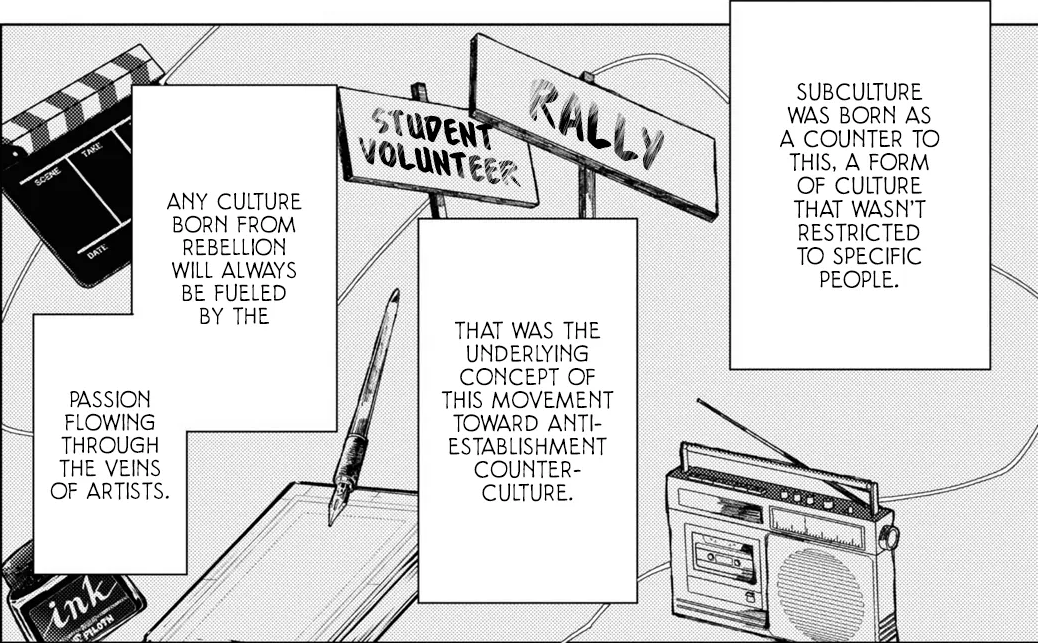
Hard to imagine a message like this from a manga about gyaru lazing around.
My endgoal by writing all of this out, unintentionally dipping my good friend in tar so they scream loud as fuck, is to challenge the notion that any degradation in language and critique quality is borne from 'the new gen' having zero aptitude for good writing. Quite the opposite - I posit this as an endemic problem of the current internet, as people have become complacent with access to nearly the world's entire art history readily available to weaponise at their disposal. Genres, labels, the 'otaku' descriptor - all of these have become mere tools to display a sense of misplaced superiority, rather than being used for the intended purpose of identifying different hobbyists and varyingly niche works of existing art fields.
Do I think anything will change by publishing this? Who knows.
I nonetheless encourage people to write about art they like, proactively critique elements they find umbrage with more openly, and foster conversations about the developments of their hobbies in a meaningful way. There's nothing wrong with being a hater. I love being a hater. Conversely, it is important to understand what it is you hate, while acknowledging any merits that can be found in a specific piece. Lack of nuance may be the standout factor behind all of these issues, but I am doing exactly what I've been protesting by flattening this broad debate into an easy phrase for internet clout. Nothing in delusion is ever that simple.
The end of this post would have originally featured a manifesto of my own re: genres and otaku, but I have outlined the majority of what I want to say. To compromise, I will instead leave you all with an excerpt from the first draft.
"Do not limit yourselves with the language of the consumer. There is no need to endlessly define your enjoyment through comparison. Showing love for the art that means something to oneself, rejecting the vagueness of genre and labels - that is perhaps the beauty, one particular truth, of 'otaku' as subculture."